Cosmetics Archives - Manton Cork

Blog

The Architect’s Guide to Acoustic Design with Natural Materials

Key Takeaways

  • Acoustic design works best when isolation, absorption, reverberation, speech privacy, and noise paths are treated as different problems.
  • Natural finish materials can contribute to acoustic comfort, but they should not be asked to perform the job of an entire tested wall or ceiling assembly.
  • Cork fits Manton Cork’s “Function Built In, Not Bolted On” point of view because its cellular structure lets a visible finish contribute useful acoustic behavior from the start.
  • For any numeric performance target, require the test method, tested assembly, product format, and installation conditions before putting the claim into a specification.

Good acoustic design with natural materials starts before a finish schedule is locked. First decide what the room needs acoustically. Then decide which part of the architecture should do each job. A wall finish can help manage reflected sound inside a room, while sound isolation between rooms depends on the larger assembly, its penetrations, its junctions, and the paths sound can take around it.

That distinction is the foundation of a useful natural-material strategy. Cork can bring warmth, tactility, tackability, and sound-absorbing behavior to a wall surface, but Manton Cork does not treat cork as a universal fix for every acoustic condition. The better approach is to build function into the design early and use each material where its mechanism actually helps.

What acoustic problem are you actually trying to solve?

Architects often hear a single complaint such as “this room is too loud,” but that complaint can describe several different problems. Before selecting a material, separate the acoustic goal into the right category.

  • Sound isolation: How much airborne sound passes from one enclosed space to another through a wall, door, ceiling, or other assembly.
  • Sound absorption: How much sound energy a surface absorbs instead of reflecting back into the room.
  • Reverberation control: How quickly sound decays after the source stops, which affects clarity, loudness, and the subjective feel of a space.
  • Speech privacy: How easily conversations can be understood at a distance or in an adjacent area.
  • Flanking transmission: Sound that travels around the primary partition through adjoining construction, penetrations, ceilings, or other indirect paths.

These are related, but they are not interchangeable. A material chosen for absorption should not be presented as if it automatically provides isolation. A high-performing partition does not necessarily make a room less reverberant. Speech privacy can involve layout, enclosure, absorption, and sometimes sound masking, depending on the project.

How should architects use STC, NRC, and reverberation time?

Sound Transmission Class, or STC, is an assembly-level sound isolation rating. ASTM E90 covers laboratory measurement of airborne sound transmission loss through building partitions and elements, while ASTM E413 provides the classification method used to calculate STC from qualifying test data. Those standards also reinforce an important design reality: field performance can be reduced by flanking paths and construction conditions.

ASTM E90 and ASTM E413 are useful when the question is separation between spaces. They do not tell you whether a finish makes the inside of a room less reflective.

Sound absorption is a surface-performance question. ASTM C423 addresses sound absorption measurements in a reverberation room and the sound absorption coefficients of absorptive specimens. NRC is commonly used as a summary absorption rating, but it should never be substituted for STC or used as shorthand for privacy.

ASTM C423 is the more relevant reference when the design question is how a surface handles reflected sound. For Manton Cork products, do not attach an NRC value unless a current, product-specific Manton source provides that tested result.

Reverberation time is a room condition. It describes how long sound persists after the source stops. It depends on room volume, surface area, furnishings, geometry, and the absorptive behavior of the surfaces in the space. That is why reverberation should be considered during planning, not after a room is complete and already difficult to use.

Where do natural materials belong in the acoustic strategy?

Natural materials are most useful when they do more than decorate the finished room. A wall or panel surface that contributes texture, warmth, tackability, and sound absorption can reduce the need to add visually disconnected acoustic treatments later.

This is the Manton Cork position: function should be built in, not bolted on. The goal is not to claim that a natural finish replaces an acoustical consultant or a tested partition. The goal is to let the finish layer carry part of the acoustic intent from the beginning.

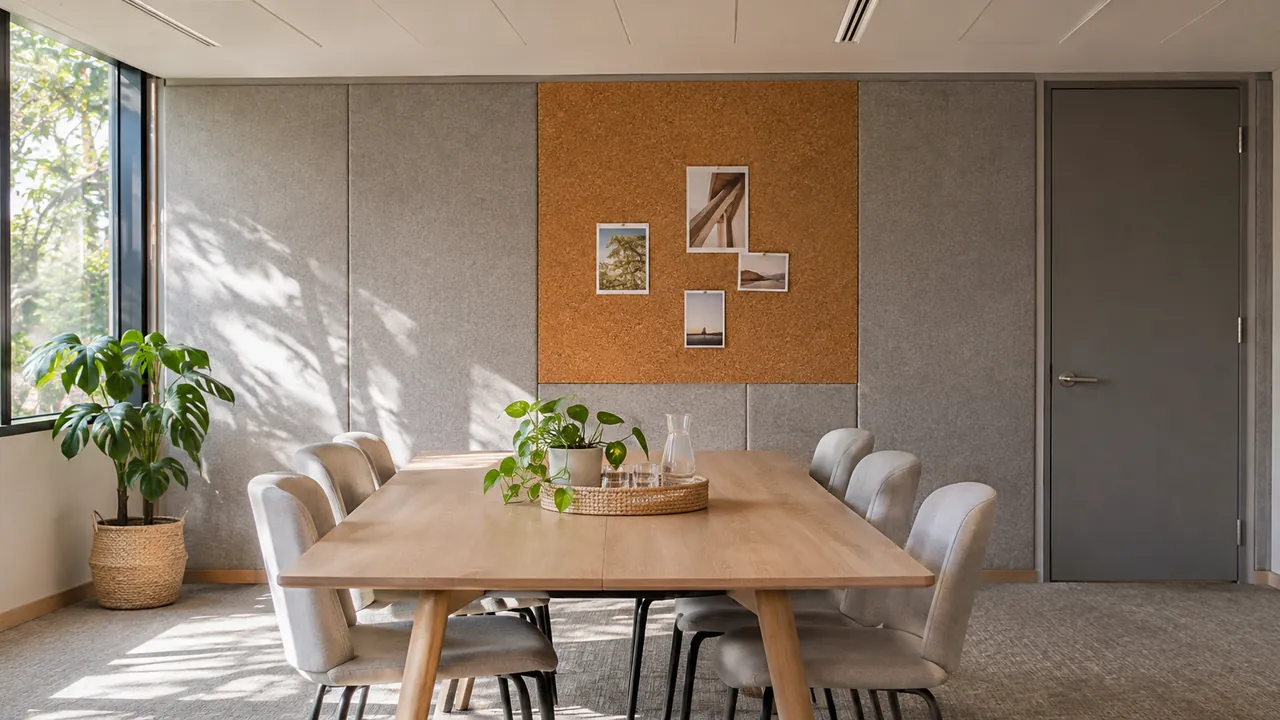
Cork is especially relevant because its structure contains many microscopic, air-filled cells. Manton describes this cellular structure as the basis for cork’s sound and vibration behavior. In architectural interiors, that makes cork a practical material to consider for wall surfaces, pin-up areas, collaboration zones, and custom panel applications where a warm natural finish can also help reduce hard-surface reflection.

See Manton Cork’s natural properties of cork overview for the material story, or review cork rolls and cork sheets when the project is moving from concept into format selection.

What should happen before the finish schedule is locked?

A useful acoustic sequence starts with the room and ends with the material, not the other way around.

  1. Map sensitive adjacencies. Identify rooms that need separation from corridors, meeting spaces, mechanical sources, classrooms, offices, or other noise-producing areas.
  2. Define the acoustic outcome. Decide whether the priority is isolation, lower reverberation, clearer speech, greater privacy, or a combination.
  3. Separate assembly performance from finish performance. Determine which requirements belong to the partition, door, ceiling, junctions, and penetrations, and which can be supported by room finishes.
  4. Reserve useful surface area early. Absorptive finish materials work only where they are actually installed. Do not wait until every wall has been assigned to glazing, millwork, displays, or equipment.
  5. Coordinate substrate and mounting. A beautiful finish that cannot be mounted correctly to the intended substrate is not a complete specification.
  6. Request evidence before finalizing numeric claims. The test method and tested configuration should match the claim closely enough that the reviewer can understand what the number represents.

What should a review-ready acoustic submittal include?

For any material carrying an acoustic claim, ask for enough information to connect the published data to the project condition. A useful submittal package should identify:

  • product name and format;
  • thickness and relevant dimensions;
  • substrate or backing condition;
  • attachment or mounting method;
  • test method used;
  • whether the published result applies to the material alone or to a complete assembly;
  • the tested configuration, including air spaces or backing materials when relevant; and
  • current sustainability or indoor-material documentation when those are separate project requirements.

Keep those evidence paths separate. A renewable or low-emitting material claim does not prove acoustic performance. An acoustic test does not prove sustainability. The specification becomes easier to defend when each requirement has its own source.

Which acoustic design mistakes create the most confusion?

  • Using STC to talk about room echo. STC concerns sound transmission through assemblies, not the reflective character of the room itself.
  • Using NRC as a privacy rating. Absorption may support privacy, but it does not by itself describe sound isolation between spaces.
  • Treating flanking noise as a finish problem. Sound that travels around a partition usually needs an assembly or detailing response.
  • Waiting until construction is nearly complete. Late acoustic fixes usually have fewer available surfaces and more aesthetic constraints.
  • Assuming natural automatically means documented. Natural materials still need product data, installation information, and project-specific verification.

Where does Manton Cork fit in an architect’s acoustic workflow?

Manton Cork is most useful when the project team has already defined the job the finish needs to do. The company supplies cork rolls, sheets, and custom-fabricated material for wall, tackable, and architectural applications, and can help translate a design intent into the right cork format.

For architects exploring cork as part of a broader finish strategy, Manton’s architectural services overview is a practical next stop. If the project requires a strict numeric isolation or absorption target, coordinate that requirement with the project acoustician and request current product-specific documentation before the specification is final.

Explore Further

Related Pages

Read more

Directory of Cork Usage in Design and Architecture

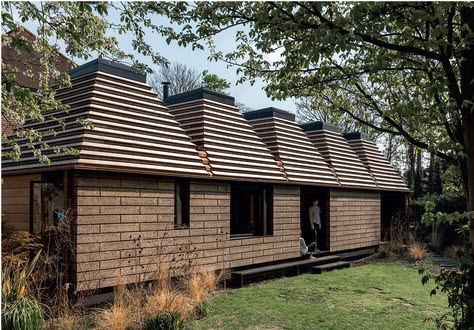
Featured image is “The finished Cork House,” photographer Ricky Jones, © Matthew Barnett Howland, from Cork Construction


This directory showcases designers and architects worldwide who are discovering—or rediscovering—the advantages of building with beautiful, practical, and renewable cork. See how cork can deliver on your clients’ demands for sustainability and environmental friendliness while expanding your possibilities for creating striking exteriors and interiors. Learn more about the Amazing Natural Properties of Cork .

Send us articles on more projects that utilize cork if you would like to have them posted here.

***

LCA Architetti nestles angular cork-clad home into Italian valley

Last, K. (2024). LCA Architetti nestles angular cork-clad home into Italian valley. Dezeen. https://www.dezeen.com/2024/02/28/lca-architetti-angular-cork-clad-home-italy/

Abstract: “An angular black volume sits atop a cork-clad ground floor to form Casa 9, a home that Italian studio LCA Architetti has added to a valley on the border between Italy and Switzerland. Located within a hilly landscape near Lake Lugano, the house was designed to showcase non-traditional building materials and features a timber structure as well as metal and cork cladding. In response to the landscape and surrounding houses, LCA Architetti designed the home to have a low-lying form, comprising a rectilinear cork-clad ground floor as well as a more angular upper level, which features a standing-seam metal roof and wall.”

Five architect-designed homes that put cork to different uses

Coates, A. (2023). Five architect-designed homes that put cork to different uses. Designs in Detail. https://www.designsindetail.com/articles/five-architect-designed-homes-that-put-cork-to-different-uses

Abstract: “Cork is a natural and renewable material that has become increasingly popular with architects in recent years. Cork building products offer several benefits, including thermal and acoustic insulation, fire resistance, moisture resistance, and durability. They are also lightweight and easy to work with, making them a perfect fit for many interior and exterior applications. Overall, cork building products offer a sustainable and eco-friendly alternative to traditional building materials. They can help create healthy and comfortable living environments, while also reducing the carbon footprint of building projects.”

Applying Exposed Cork in Interior Architecture

Cortés, C. V. (2023). Applying Exposed Cork in Interior Architecture. Arch Daily. https://www.archdaily.com/960854/applying-exposed-cork-in-interior-architecture

Abstract: “How can we transport ourselves to natural environments when we are in completely urban situations? The materiality of our surroundings is an important factor that determines the atmosphere we inhabit. In many cases, the use of natural materials in interior architecture can help evoke nature in our daily spaces. In this article, we will specifically analyze the effect that cork has as a special resource in the design of interior spaces.”

Building with Cork

Gué, V., (2021). Building with Cork. Critical Concrete. https://criticalconcrete.com/building-with-cork/

Abstract: “Cork has some remarkable qualities and can be used for many different purposes, it is even applied in space as thermal insulator for space shuttles. It is light, durable, elastic, waterproof, fire retardant and has great insulation properties. Furthermore, it is 100% reusable. The structure is composed out of tiny gas-filled cells, creating a huge disproportion between the volume and the weight of the material, more than half of its volume is air. These properties make cork incredibly useful as a building material, whether as flooring, insulation sheets or surface finish. The cork can have different shapes: insulation panels, coatings flooring, cork stoppers, composite agglomerates, raw material. If the material is used raw and 100% natural (if the process is free from chemical substances), it can provide an ecological alternative to conventional solutions, not least because of the barks ability to absorb CO2 during the regeneration process. Regularly harvested cork trees store 3 to 5 times more CO2 than those left unharvested.”

Cork Construction

Wilton, O., & Howland, M. B. (2020). Cork Construction Kit. The Journal of Architecture, 25(2), 138–165. https://doi.org/10.1080/13602365.2020.1733812

Abstract: “This article reports on the research and development of a radically simple new form of solid, dry-jointed construction made of expanded cork and engineered timber. It has outstanding whole life performance, and the potential to help sustain biodiverse landscapes, and create buildings with exceptionally low whole life carbon emissions. Building blocks made of cork forestry waste interlock for quick and easy assembly, creating buildings that are low-energy to inhabit and simple to disassemble at the end of the building’s life for reuse. The project investigates an architectural language of cork stereotomy as a progressive reimagining of historic dry-stone construction.”

Wine Be Damned, Cork Is For Building

Brownell, B. Wine Be Damned, (2018) Cork Is For Building. Architect Magazine, https://www.architectmagazine.com/practice/wine-be-damned-cork-is-for-building_o

Abstract: “From flooring to façades, cork has entered the product arena as an environmentally friendly, viable construction option. …Cork’s use in buildings is nothing new. In fact, ancient Egyptians, Greeks, and Romans used cork for various functions, including building insulation, ship flotation, and footwear. …Today, cork has rebounded thanks to three critical factors: higher quality processed material, increased public awareness about its environmental performance, and market diversification to sectors including architecture and design.”

Proof That Cork Can Be a Beautiful and Practical Design Practice

Allen, E. (2017). Proof That Cork Can Be a beautiful and Practical Design Practice. Architectural Digest HOMES + DECOR
https://www.architecturaldigest.com/gallery/cork-beautiful-practical-design-practice

Abstract: “Cork has taken a few stops on its winding journey to showstopping interior design element: From the wine industry as bottle-stoppers (its most common and most lucrative use), then to badminton shuttlecocks and bulletin boards, next to a purely functional use in architecture as sub-flooring and insulation, and finally the walls, ceilings and floors in the homes featured in AD. The woody material’s pragmatic use in architecture is well deserved because of its elastic, cellular structure, its thermal-regulating and soundproofing qualities, and its natural resistance to fire, but it’s the cork’s natural warm hue and subtly dappled texture that are the secret to its modern design success. The versatile material can be dyed or painted (and still maintain its speckled look), it can be applied to walls and ceilings, and its inherent durability make it a prime choice for floors. Here, AD explores the varied uses of cork in spaces like one of Seth Meyers’s dressing rooms, a summer house designed by Thom Filicia, and the modernist home of GQ‘s Fred Woodward.”

The Future of Materials: 7 Quirky Buildings Clad in Cork

Hogue, P. (undated). The Future of Materials: 7 Quirky Buildings Clad in Cork. Architizer. https://architizer.com/blog/inspiration/collections/future-of-materials-quirky-cork-cladding/

Abstract: “…Yet, the qualities that have made cork a choice material for civilizations can also surprisingly be applied to architecture. As a lightweight, impermeable, sustainable and durable material with incredible insulation capabilities, cork is a surprisingly versatile material in the construction field. In the past few years, architects have truly started to put cork to the test, and the results are pointing toward limitless potential. As the seven ‘corky’ buildings below illustrate, we should start asking the question: could cork become the mass-scale construction material of the future?”

Could Cork Be Nature’s Answer to Our Environmental and Construction Needs?

Thorns, E. (2017). Could Cork Be Nature’s Answer to Our Environmental and Construction Needs? Arch Daily. https://www.archdaily.com/884983/could-cork-be-natures-answer-to-our-environmental-and-construction-needs

Abstract: “Unbeknown to many, cork is something of a dark horse when it comes to the environment—a model of a sustainable industry and building material. By its very nature, cork is both recyclable and renewable, as it is the only tree that regenerates its bark, while harvesting that bark causes the tree no harm. Cork has been sneaking its way into our buildings for many years now; due to its hard-wearing properties it can be found, for example, in the checkerboard flooring of the Library of Congress. Even NASA has been wise to cork’s light weight and insulation capacity, using it as an insulator for their space shuttles. Only recently have we seen a growing curiosity over cork as an external cladding material for buildings. Despite what many assume, cork is extremely waterproof (why else would we trust it as a stopper for our precious wine), resistant to abrasion, and acts as a fire retardant and an acoustic insulator. Its also has desirable aesthetic qualities, giving buildings mottled earthy tones and natural patterning.”

Read more

This ancient material is displacing plastics and creating a billion-dollar industry

  • By admin
  • February 20, 2024
  • Blog

By M. Vidal. Feb. 20, 2024. This ancient material is displacing plastics and creating a billion-dollar industry. Washington Post.

https://www.washingtonpost.com/climate-solutions/2024/02/03/cork-sustainable-material/

“We are seeing a growing interest in cork as a sustainable material,” says Rui Novais, a materials expert at the University of Aveiro in Portugal. “Compared with materials like polyurethane foam [used for thermal insulation], products made with cork require less energy and produce less CO2 emissions.”

Read more

Chipotle CEO Brian Niccol on the future of Chipotlanes, premium delivery pricing and why the brand has nurses check on sick employees

  • By admin
  • April 29, 2021
  • Blog

The chief executive explains to New York investors how the chain has regained consumer trust; the brand also rolls out a new prototype store

Read more

Could Cork Save the Beauty Industry’s Carbon Footprint?

When you think of a cork, if you do, you probably think of wine stoppers, or maybe dartboards. But cork jars and compacts? Those are new.

Read more

Need help? Please Contact Us

How Can We
Help You Today?

Your cart is empty Shop Now