
Biophilic Design Materials: A Practical Guide
- By John Matera
- November 19, 2026
- Design
Key Takeaways
- Biophilic design materials should create a meaningful connection to nature through material origin, texture, pattern, variation, and sensory experience, not just imitate a natural look.
- The strongest choices do two jobs at once: they support the visual concept while also serving a practical role such as a wall finish, tackable surface, custom feature, or part of an acoustic strategy.
- Material authenticity does not replace specification discipline. Substrate, installation, maintenance, emissions documentation, fire requirements, and project-specific performance still need to be verified.
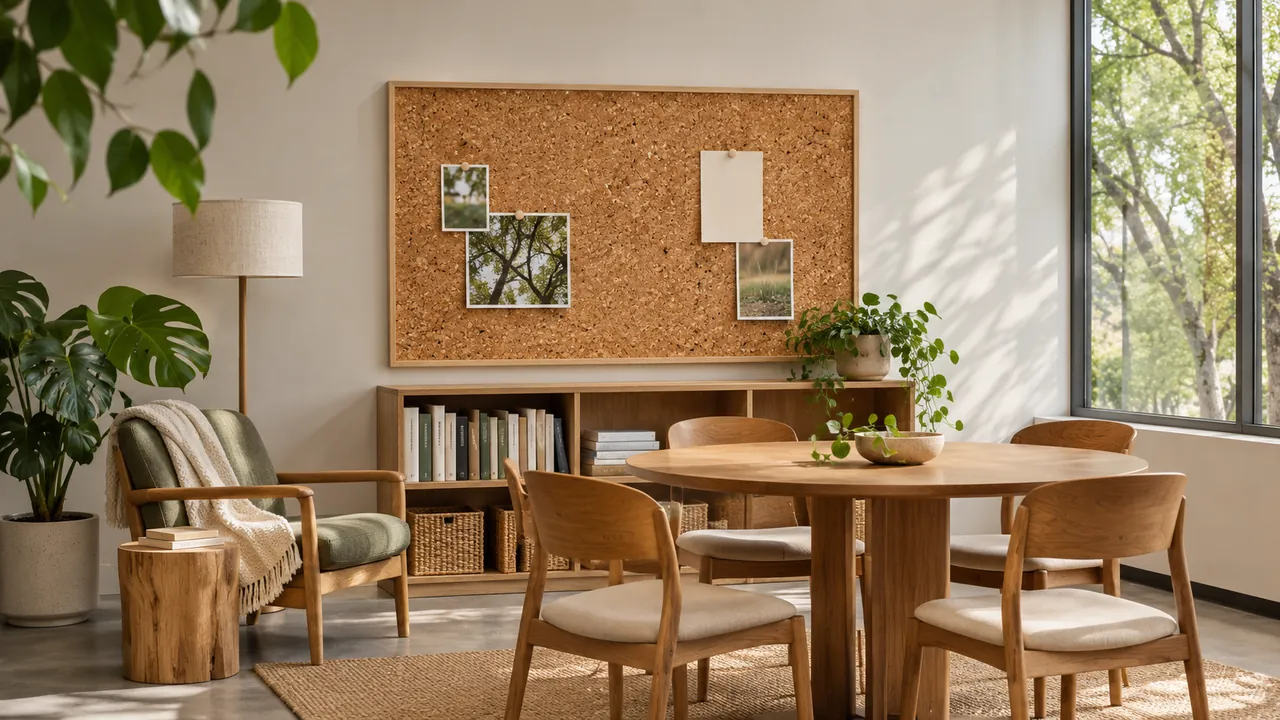
- Cork is useful in biophilic interiors because the natural material remains visually legible in the finished surface and can be supplied in rolls, sheets, wall applications, and custom-fabricated forms.
Biophilic design materials work best when they connect people to nature without becoming set dressing. Natural origin matters, but so do texture, variation, touch, durability, installation, and the job the material performs in the room. A convincing biophilic palette is not simply a collection of brown and green finishes. It is a material strategy.
That is an important distinction for interior and commercial designers. The goal is not to make a synthetic room look vaguely organic. The goal is to make nature legible through real material choices, patterns, sensory cues, daylight, planting, views, and other design decisions that reinforce one another.
What actually makes a material biophilic?
Biophilic design can include direct nature, such as plants and daylight, as well as natural materials, forms, patterns, and textures. The WELL Building Standard has long recognized natural materials and patterns as valid ways to incorporate biophilic intent into a project. That gives designers a useful starting point, but it does not turn material selection into a checklist.
A practical material review should ask five questions:
- Is the connection to nature authentic? Consider whether the material itself comes from a natural source or whether it only reproduces the appearance of one.
- Can people perceive the material character? Texture, grain, variation, warmth, and tactility matter because biophilia is experienced at human scale.
- Does it do useful work? A surface that supports a real room function usually earns its place more convincingly than a decorative layer added only for visual effect.
- Can it survive the application? Traffic, cleaning, contact, mounting conditions, seams, and repair expectations still matter.
- Can the project team document it? Sustainability, emissions, acoustic, and fire requirements should be supported by the appropriate current documentation rather than assumed from the word natural.
This is the Manton Cork point of view in practice: natural materials are strongest when their function is inherent in the material, not added as an afterthought.
Why does material authenticity matter?
Visual references to nature can be useful, but a printed grain and a natural surface create different design experiences. Real materials carry small variations in color, texture, density, and pattern that make the surface read as material rather than graphic.
That difference becomes more noticeable at touch distance. A conference room wall, collaboration surface, reception feature, classroom pin-up area, or retail display is experienced from a few feet away, not only in a rendering. The hand, edge condition, seam pattern, and response to light become part of the design.
Cork is especially legible in this way. The material is harvested bark from the cork oak, and its natural grain remains visible in rolls, sheets, wall surfaces, and fabricated pieces. Designers do not need to print a cork pattern onto another substrate to get the visual language of cork. The material itself provides it.
How should designers evaluate biophilic materials beyond appearance?
A useful specification matrix moves beyond color and texture. It should connect sensory goals with project requirements.
| Design question | What to evaluate | Why it matters |
|---|---|---|
| How does the material connect to nature? | Origin, grain, pattern, tactile quality, natural variation | Separates authentic material experience from surface imitation |
| What job does the surface perform? | Wall finish, tackable area, display surface, custom feature, acoustic contribution | Helps the material earn space in the program |
| How will it be installed? | Format, thickness, substrate, seams, mounting or adhesive requirements | Turns a sample-board idea into a buildable detail |
| How will it age? | Contact, cleaning, maintenance, replacement strategy, edge protection | Keeps the design intent intact after occupancy |
| What must be documented? | Product data, sustainability information, emissions data, project-specific test reports | Prevents natural-material language from substituting for evidence |
This approach is especially useful on commercial projects because a finish rarely gets approved on aesthetics alone. The project team eventually needs dimensions, installation details, maintenance expectations, and supporting documents.
Where does cork fit in a biophilic material palette?
Cork works well when a design needs a warm, natural surface that can remain visible and useful. Manton Cork supplies cork rolls, cork sheets, wall-oriented applications, and custom cork fabrication. That gives designers several ways to bring the same material language into different scales of a project.
Its cellular structure also gives cork useful sound-absorbing behavior. That can make cork relevant when the design intent includes acoustic comfort as well as visual warmth. The careful wording matters: Manton Cork does not publish a universal NRC or STC value for its current product line, so cork should not be assigned a numeric acoustic rating without current product-specific test documentation.
The stronger claim is simpler. Cork can be part of an integrated acoustic strategy while remaining a visible natural finish. That is more useful than treating acoustics as a separate layer that appears only after the room feels too reflective.
How much biophilic material does a room need?
There is no universal percentage that turns a space into a biophilic interior. The right amount depends on scale, sightlines, circulation, the room’s use, and the strength of the other natural elements in the design.
Start with the surfaces people actually experience. A full-height wall at the end of a circulation path can have more impact than several small decorative inserts. A tackable collaboration wall can create daily contact with a natural material. A reception or retail feature can establish the material story immediately. In a quiet room or meeting space, a natural wall surface can also support the intended sensory character.
Then look at repetition. If the same natural material appears in every room without regard for use, the strategy can feel generic. It is often stronger to identify the places where the material has a reason to be there and let those applications carry the story.
What should a large sample review include?
Small samples are useful for initial palette work, but natural materials should be reviewed at a scale large enough to reveal variation, seams, and lighting behavior. Before a client presentation or final finish selection, consider:
- grain and color variation across multiple pieces;
- the appearance of seams and edge conditions;
- how directional and ambient light affect the surface;
- the relationship between material thickness and the adjacent trim or millwork;
- how the substrate affects flatness and installation;
- whether the area needs to be tackable, decorative, absorptive, or multifunctional; and
- what cleaning and maintenance expectations apply in the room.
Manton’s design and architecture directory can help teams see how cork has been used across different environments before moving into a specific format or detail.
How can biophilic materials support different commercial spaces?
Commercial offices
Use natural materials where people gather, collaborate, focus, or transition between work modes. Cork can function as a visual wall surface, a pin-up zone, or part of a finish strategy intended to reduce the dominance of hard reflective surfaces.
Education spaces
Classrooms, libraries, studios, and common areas often need surfaces that support display and daily use. A natural tackable wall can connect the biophilic idea to a functional need rather than reserving nature for decorative moments.
Retail and branded environments
Natural material can become part of the brand experience when it is used in displays, fixtures, wall areas, or custom-fabricated elements. Cork is especially adaptable here because Manton can fabricate custom shapes from drawings or sketches.
Hospitality and gathering spaces
Texture and material warmth can help establish a more grounded visual character in lounges, meeting rooms, reception areas, and other spaces where people spend time at close range. The selection still needs to account for maintenance, detailing, and any project-specific code requirements.
What should be verified before the material is specified?
Biophilic intent should survive the submittal process. Before a natural finish is locked into the project, confirm the exact product format, thickness, dimensions, substrate, installation method, maintenance needs, and required documentation.
If the project carries sustainability, indoor-air, acoustic, or fire criteria, request the current supporting information for the proposed product and assembly. Do not assume a broad material story automatically satisfies a project-specific requirement.
That discipline does not weaken the biophilic concept. It strengthens it. The most credible natural-material strategy is one the design team can defend aesthetically, technically, and operationally.
Make the natural surface do real work
Biophilic design is most convincing when the material is not there merely to signal nature. Give the surface a job, place it where people can experience it, and detail it with the same rigor as any other commercial finish.
If cork is part of the palette, review Manton Cork’s architectural applications and available roll, sheet, and custom formats. A larger material sample is often the best next step for judging grain, scale, texture, and how the surface will actually read in the room.
Explore Further
- Cork Material Science: A Working Handbook for Specifiers
- Why Natural Materials Absorb Sound
- The Specifier’s Guide to Genuinely Sustainable Interior Materials
- The Architect’s Guide to Acoustic Design with Natural Materials
- Choosing Non-Toxic Wall Finishes: A Verification-First Method