
Cork Material Science: A Working Handbook for Specifiers
- By John Matera
- November 18, 2026
- Architecture
Key Takeaways
- Cork is bark from the cork oak, not wood, and its cellular structure explains much of its low density, resilience, low permeability, and acoustic behavior.
- General cork properties and Manton-specific product data should be kept separate. Material science explains the mechanism; product data establishes what a specific Manton material has actually been tested to do.
- Manton’s MC38 data for composition cork roll and sheet documents tensile strength, compression, recovery, density, and a boiling-water qualification test.
- STC, NRC, R-value, fire-class, and similar ratings should not be assigned to Manton products unless a current product-specific source supports the exact claim.
This cork material properties guide is built for specifiers who need to move from “cork is a natural material” to a more useful engineering question: which properties matter for the intended application, what mechanism creates those properties, and what evidence supports the product being specified?
The most important distinction is between general material behavior and product-specific tested performance. Cork’s cellular structure can explain why the material is light, compressible, resilient, and useful in sound-control applications. A Manton product data sheet can document specific physical properties for a defined composition cork material. Those are complementary forms of evidence, but they are not interchangeable.
What is cork at the material level?
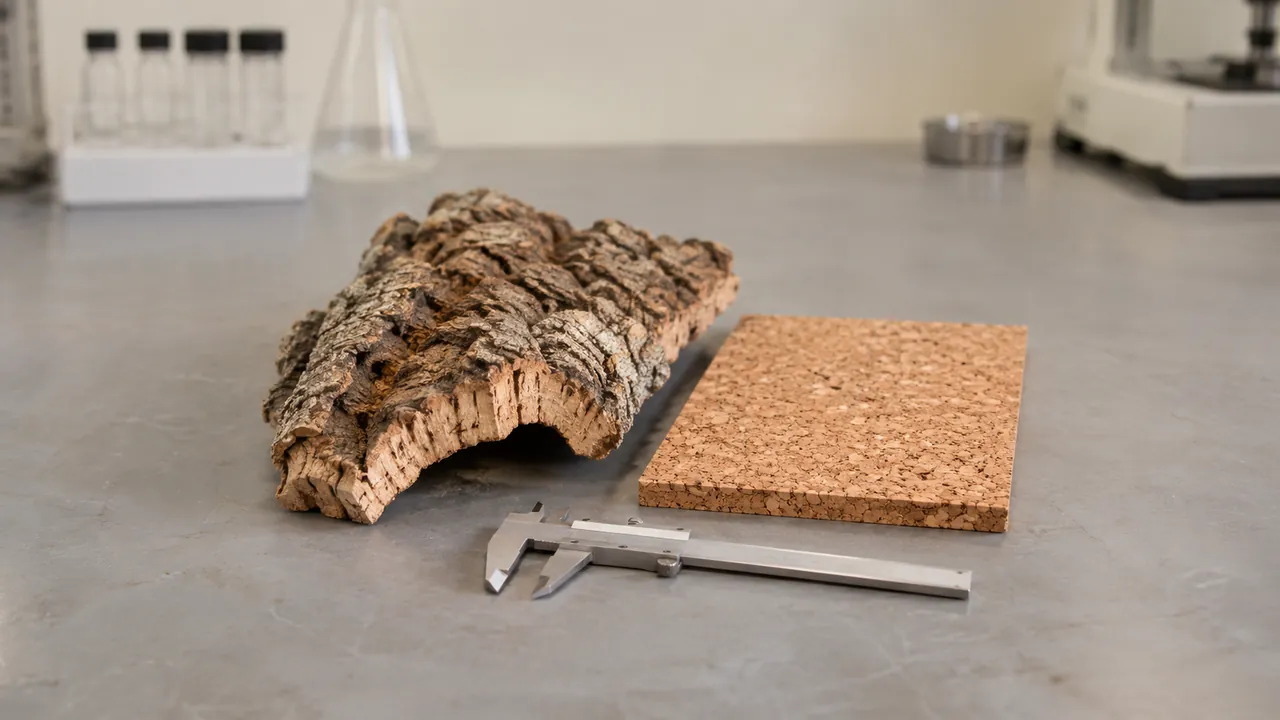
Cork is the protective outer bark of the cork oak, Quercus suber. That matters because bark can be harvested while the tree remains alive and can regenerate for later harvest cycles. It also matters technically because cork is not a solid wood with the same grain structure and response to pressure.
Manton describes cork as a material made of millions of microscopic, air-filled cells. That cellular structure is central to several behaviors specifiers care about. The material is lightweight, can compress under load, can recover after compression, and can absorb or damp some energy rather than behaving like a hard reflective surface.
The cellular structure also helps explain cork’s low permeability. Cork tissue contains suberin, a naturally occurring waxy substance associated with resistance to the passage of liquids and gases. In a specification, that mechanism is more useful than a vague statement that cork is simply “waterproof” or “impermeable” in every condition.
Which cork properties matter most to a specifier?
Cellular structure and low density
Cork contains a high proportion of air within its cell structure. That helps explain its low density and why the material feels lighter and softer than many mineral, wood-based, or solid polymer surfaces. Low density is a material characteristic, not a complete durability or structural rating, so it should be paired with product-specific data when the application is demanding.
Compression and recovery
Cork can deform under pressure and recover a meaningful portion of that deformation after the load is removed. This is the basis for describing cork as resilient. It is also why Manton Cork’s content rules favor precise terms such as “compression recovery” and “rebounds after compression.” Recovery from compression does not mean the material repairs cuts, punctures, or other damage.
Low permeability and suberin
Suberin contributes to cork’s resistance to liquid and gas penetration. For architects, this is best treated as a material characteristic that helps explain cork’s behavior, not as permission to make an unsourced claim about every finished cork product, adhesive system, or installation condition.
Acoustic and vibration behavior
Cork’s air-filled cellular structure gives it a useful mechanism for absorbing and dissipating energy. That supports qualitative statements about sound absorption, vibration dampening, and acoustic comfort. It does not establish a specific NRC, STC, or whole-room acoustic result for a Manton product unless a current test report supplies that rating.
Fabrication potential
Cork can be supplied in rolls, sheets, and fabricated shapes. Manton Cork also works with composition cork in different grain structures and offers custom fabrication for applications that move beyond a simple rectangular sheet. From a specifier’s perspective, this means material selection and fabrication strategy can be coordinated rather than treated as separate sourcing problems.
What Manton-specific physical data is actually published?
Manton Cork publishes Product Data MC38 for composition cork roll and sheet. The current page reports the following physical properties and qualification data:
| Test method | Property | Manton MC38 specification |
|---|---|---|
| ASTM F152, Method B | Tensile strength | Greater than 43.5 psi |
| ASTM F36, Procedure F | Compression at 100 psi | 30 to 45% |
| ASTM F36, Procedure F | Recovery after compression | Greater than 75% |
| ASTM F1315 | Density | 10 to 14 lb/ft³ |
| ASTM F148, Procedure A | Boiling-water qualification | No disintegration after 3 hours |
These are useful because they turn general material language into a product-specific evidence path. They are also narrow by design. Tensile strength is evidence about tensile behavior. Compression and recovery are evidence about response to compressive loading. Density documents mass per unit volume. The boiling-water qualification result documents the condition described by that test.
Do not stretch one test into a different claim. A recovery result is not an NRC rating. A tensile-strength value is not a fire classification. A boiling-water qualification result is not a blanket moisture warranty. The test earns credibility only when the claim stays tied to the property actually measured.
How should architects interpret compression and resilience?
Resilience is one of cork’s most useful traits, but it is easy to overstate. In specification language, the safest approach is to describe the behavior that can actually be supported: cork compresses under load and can recover after compression.
For wall and tackable applications, that behavior helps explain why cork can feel forgiving under repeated contact and why it works well as a pin-up surface when the thickness, substrate, and installation are appropriate. It does not mean the surface is immune to wear or that physical damage disappears.
Manton’s MC38 recovery figure gives a specifier a product-specific reference point for the tested composition cork material. If a project depends on repeated loading, unusual fabrication, or another demanding condition, ask Manton for the current data sheet and confirm that the proposed product is the material covered by that data.
What can be said about cork’s acoustic behavior?
Cork can support acoustic comfort because its cellular structure does not behave like a completely hard, reflective finish. Manton’s own material descriptions refer to sound insulation, sound absorption, and vibration-dampening behavior as benefits of the cellular structure.
For specification purposes, keep the language qualitative unless a verified project-specific rating is available. A wall finish can contribute to room absorption, but that is different from the sound isolation of a complete partition. If the design requires a defined STC, NRC, or reverberation target, coordinate the tested requirement separately and confirm how the cork finish fits within the larger acoustic design.
This is the same principle used throughout Manton Cork’s acoustic guidance: function built in, not bolted on, but never inflated beyond the evidence.
How does cork move from raw material to architectural product?
Architects rarely specify “cork” in the abstract. They specify a format, thickness, finish, substrate, attachment method, and use condition.
Manton supplies cork rolls, cork sheets, and industrial or custom cork products that can be cut or fabricated for the job. The appropriate format depends on whether the design needs continuous wall coverage, discrete panels, tackable areas, custom shapes, fabricated components, or another project-specific condition.
That is where Manton’s material expertise matters most. A specifier should not have to separate the material science from the practical sourcing question. The useful conversation is: what property does the project need, which cork format expresses that property appropriately, and what documentation should accompany the final selection?
What belongs in a cork specification or submittal?
A strong cork specification should make the material easy to identify and easy to review. At minimum, consider documenting:
- product or material designation;
- cork format, such as roll, sheet, or custom-fabricated component;
- thickness and dimensions;
- grain or composition type when relevant;
- substrate and mounting or adhesive requirements;
- required physical-property documentation;
- required sustainability or chain-of-custody documentation;
- samples or appearance requirements when color and grain are design-critical; and
- any project-specific acoustic, fire, or emissions requirement that needs separate verification.
If the project calls for a tested property, name the property and request the current supporting document. Avoid writing a broad performance sentence and expecting the submittal reviewer to infer which test was intended.
Which claims should trigger a verification check?
Several terms deserve an automatic pause because they can easily move beyond the available evidence. Before using any of the following in a Manton Cork specification, verify the current product-specific source:
- a specific STC or NRC rating;
- a specific R-value or thermal-resistance number;
- a specific fire class or fire-test result;
- a claim that recovery from compression means the material repairs physical damage;
- a whole-product carbon conclusion not supported by an appropriate life-cycle source; or
- any certification claim that depends on a current certificate, transaction, or special-order material.
The point is not to weaken the material story. It is to keep general material science, Manton-specific product data, and project-specific requirements in the correct evidence lanes.
How should a specifier use Manton Cork’s material expertise?
Start with the material property that matters to the design. Then connect it to the right Manton format and the right evidence. The MC38 cork roll and sheet data is the logical reference when the project needs documented physical properties for the covered composition material. Manton’s architectural services content is useful when the question is format, fabrication, or application.
When the project becomes unusual, a direct conversation is often more efficient than forcing a generic data sheet to answer a custom question. Manton Cork has worked with cork as a specialty material for more than a century. Use that expertise to connect the material mechanism, the product format, and the submittal requirement before the specification is final.
Explore Further
- Why Natural Materials Absorb Sound
- How Cork Oak Forests Work as Carbon Sinks
- The 55-Pound Figure: What Cork’s CO2 Absorption Number Actually Means
- Specifying and Sourcing Custom Cork: From Drawing to Delivery
- Biophilic Design Materials: A Practical Guide